
Email deliverability is all about one simple thing: getting your emails into your subscribers' main inboxes. Not the spam folder. Not the promotions tab. And definitely not bounced back to you.
It’s the make-or-break factor that decides whether your message gets seen or completely ignored, making it the absolute cornerstone of any serious email marketing strategy.
Breaking Down Email Deliverability

Think of it like sending a package. Just because you dropped it off at the post office doesn't guarantee it will end up on the recipient's doorstep. The address could be wrong. The recipient might have moved. The package could even get flagged by security and never make it.
What is email deliverability? It’s the digital version of that entire journey. It's the art and science of ensuring your email not only gets sent but actually arrives in the inbox, ready to be opened.
Deliverability vs Delivery: What Is the Difference?
This is where a lot of people get tripped up. The terms delivery and deliverability sound similar, but they mean completely different things.
Understanding this distinction is the first step to mastering your email outreach. Let's break it down.
| Concept | What It Means | Example |
|---|---|---|
| Delivery | This is purely technical. It just confirms that the recipient's server accepted your email. Think of it as the post office accepting your package. | Your email service provider reports a 99% delivery rate. This means 99% of your emails were successfully handed off to the receiving mail servers. |
| Deliverability | This is the true measure of success. It tells you where your email landed after being accepted—the inbox, the spam folder, or a promotions tab. | Your campaign has a high delivery rate, but only 60% of your emails made it to the primary inbox. The other 39% went to spam. Your deliverability needs work. |
A high delivery rate with poor deliverability means you're basically shouting into the void. Your messages are being sent, but nobody's hearing them.
The goal isn’t just to send emails; it's to get them seen. Focusing on deliverability is what turns a technical "send" into real-world engagement and results.
This directly impacts your sales and marketing. Consistently landing in the spam folder wrecks your sender reputation, making it even harder for future emails to get through. Internet Service Providers (ISPs) like Gmail and Outlook are always watching. High engagement from recipients tells them your content is valuable. High spam complaints tell them it's junk.
For B2B companies, this is everything. The average delivery rate for B2B emails is a surprisingly high 98.16%. This shows that when done right, cold emailing is still an incredibly powerful tool for generating leads. You can dive deeper into these email deliverability statistics to see how they affect business outreach.
Ultimately, strong deliverability is the foundation of a healthy email program. It ensures all the hard work you put into crafting your message actually pays off.
The Four Pillars of Strong Email Deliverability
To really get what email deliverability is all about, you have to look beyond a single metric. It’s more like a complete system built on four distinct but connected pillars. Get each one right, and you're on your way to consistent inbox placement and campaigns that actually work.
Think of it like building a house. You can’t expect a stable structure without a solid foundation, strong walls, a good roof, and a welcoming front door. Each part absolutely depends on the others to hold everything together.
Pillar 1: Your Technical Infrastructure
Your technical infrastructure is the digital foundation of your entire email program. This covers everything from your sending domain to the email service provider (ESP) you use. A proper setup signals to Internet Service Providers (ISPs) like Gmail and Outlook that you're a legitimate, professional sender, not some fly-by-night operation.
A poorly configured infrastructure is like building on shaky ground. Even the most brilliant email content will fail to reach the inbox if the technical basics aren't locked in. This is also where your sending domain's history and age play a big role.
Pillar 2: Email Authentication Protocols
If infrastructure is the foundation, then authentication is your email’s official passport. It’s a set of technical standards that prove your emails are genuinely from you and not from a scammer impersonating your brand. This verification process is all about building trust with ISPs.
The three key authentication protocols you need to know are:
- SPF (Sender Policy Framework): This record basically lists all the mail servers that have permission to send emails on behalf of your domain.
- DKIM (DomainKeys Identified Mail): This adds a unique digital signature to your emails, which receiving servers can check to confirm nothing was tampered with.
- DMARC (Domain-based Message Authentication, Reporting & Conformance): This protocol tells ISPs what to do with emails that fail SPF or DKIM checks, which is huge for protecting your brand from being spoofed.
Implementing all three isn't just a recommendation anymore; it's a modern requirement for any serious email marketer. It's your first line of defense against being flagged as suspicious.
Pillar 3: Sender Reputation
Your sender reputation is your credit score in the email world. It’s a score that ISPs assign to your sending domain and IP address based on your sending habits over time. A high score means you're trusted, and your emails are far more likely to land in the inbox.
A poor reputation, often caused by high bounce rates or spam complaints, can get your messages sent straight to the junk folder. This is exactly why maintaining a clean email list is so critical; sending to invalid addresses is one of the fastest ways to torpedo your reputation. For anyone looking to boost their sender score, we've put together a practical guide to email list cleaning.
This graphic breaks down the core elements that all work together to influence your deliverability.
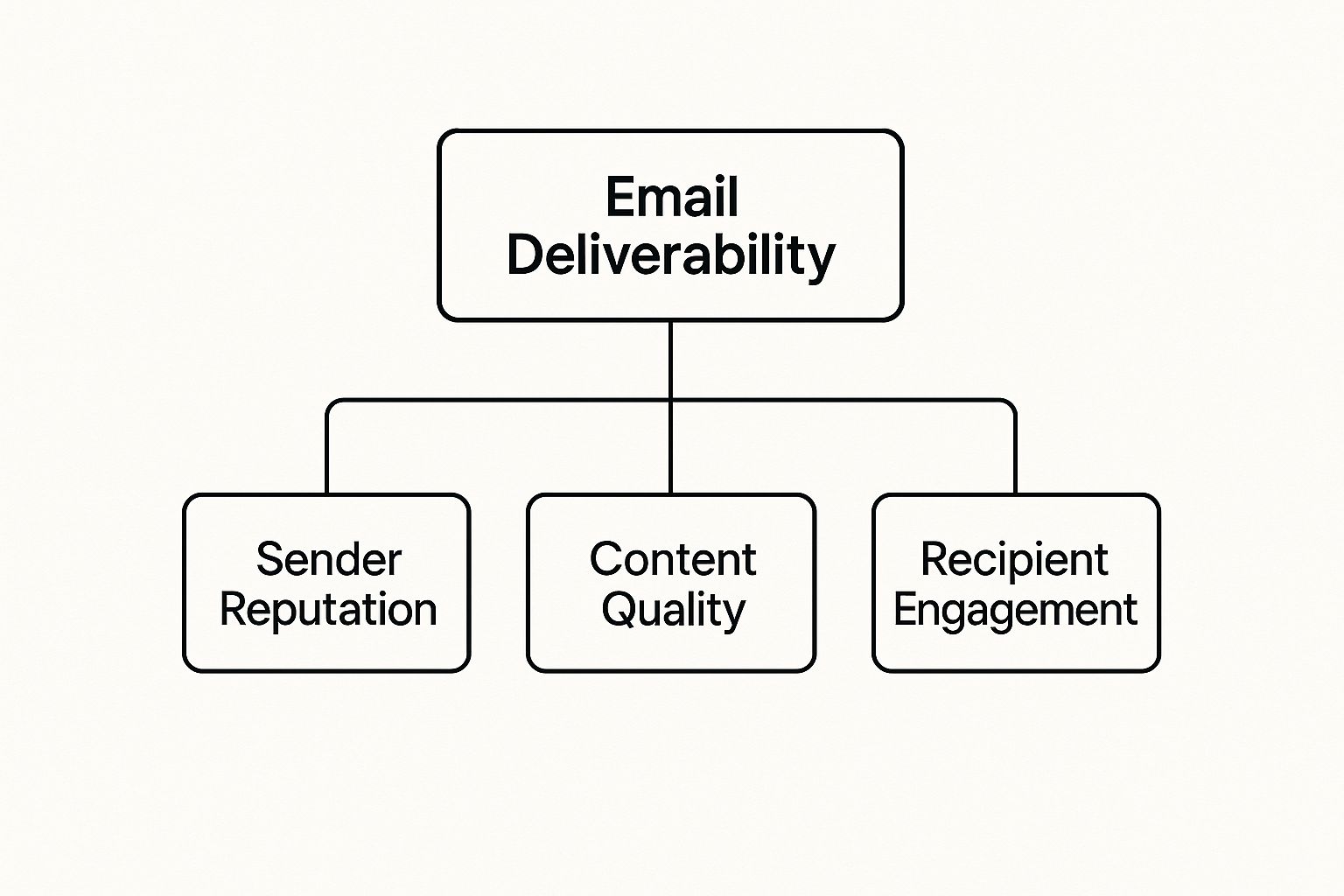
As you can see, sender reputation, content quality, and what your recipients do are all central to achieving strong deliverability.
Pillar 4: High-Quality Content
Finally, the content inside your email is the last critical pillar. This includes everything from your subject line and preview text to the body copy, images, and links you use. Spam filters are constantly analyzing your content for red flags that suggest something spammy or low-value.
Things that can really hurt your content score include:
- Using spammy trigger words like "Free!" or "Act now!" over and over.
- Including broken links or linking out to sketchy websites.
- Having way too many images and not enough text.
Ultimately, your goal should always be to provide real value. Engaging, relevant, and personalized content not only breezes past spam filters but also encourages positive interactions from recipients, which in turn boosts your sender reputation. It all comes full circle.
Key Metrics to Monitor Your Email Health

Knowing the theory behind email deliverability is a great start, but to actually manage it, you have to measure it. Think of email metrics as the vital signs for your marketing campaigns—they tell you what’s working, what isn’t, and when you need to step in.
Monitoring these numbers is how you stop guessing and start making smart, data-driven decisions. Each metric tells a piece of a larger story about your sender reputation and how your audience feels about your emails. Let's dig into the most critical ones you should be watching.
The Critical Role of Bounce Rates
A bounce is simple: your email couldn't be delivered. But not all bounces are created equal. They fall into two distinct categories that point to very different problems with your email list.
- Hard Bounces: This is a permanent dead end. It happens when an email address is fake, invalid, or simply doesn't exist anymore. A high hard bounce rate is a huge red flag for Internet Service Providers (ISPs), signaling that your list is poorly maintained and you might be a spammer.
- Soft Bounces: This is a temporary hiccup. The recipient's inbox might be full, their server could be down for a bit, or your email file is just too large. While less severe, if you keep getting soft bounces from the same address, ISPs will eventually start treating it like a hard bounce.
You absolutely need to keep your hard bounce rate below 2%. Anything higher is a clear sign your list needs an immediate deep clean to protect your sender reputation.
Your bounce rate is the most direct indicator of your email list's health. Consistently high bounces are like trying to send mail to abandoned houses—it tells the post office (ISPs) that you don't know who you're sending to.
Engagement Metrics: Open and Click-Through Rates
While bounces tell you about list quality, engagement metrics show you how your audience is actually reacting to your content. These numbers directly influence your sender reputation because they prove to ISPs that people want to get your emails.
But getting that attention is tough. Over 347 billion emails fly around the globe every day. With all that noise, the average open rate sits around 24%, and the click-through rate is a mere 3.5%. Standing out is a real challenge. You can see a full breakdown of key email marketing statistics to get a better sense of the landscape.
Negative Signals: Spam Complaint and Unsubscribe Rates
Finally, you have to track the bad signals. The spam complaint rate is exactly what it sounds like—the percentage of people who mark your email as spam. This is the single most damaging metric for your reputation. If this number climbs above 0.1%, you're in the danger zone.
The unsubscribe rate, on the other hand, is a much healthier negative signal. It’s not great, but it shows that people are using the proper way to opt out instead of just hitting the spam button. A high unsubscribe rate might mean your content isn't hitting the mark, but it's far, far better than a high spam complaint rate.
To keep things simple, here's a quick checklist you can use to gauge the health of your email program at a glance.
Email Deliverability Health Checklist
Think of this table as your email program's report card. If your numbers are within these healthy benchmarks, you're on the right track. If not, it’s time to identify the problem area and take action.
| Metric | Healthy Benchmark | What It Signals |
|---|---|---|
| Hard Bounce Rate | Below 2% | The quality and accuracy of your email list. High rates mean your list is outdated or contains invalid contacts. |
| Spam Complaint Rate | Below 0.1% | How relevant and welcome your emails are. High rates are a major red flag for ISPs and will crush your reputation. |
| Open Rate | 20-25% (Varies by industry) | The effectiveness of your subject lines and brand recognition. Shows initial interest from your audience. |
| Click-Through Rate | 2-5% (Varies by industry) | The quality and relevance of your email content and call-to-action. Shows deeper engagement. |
| Unsubscribe Rate | Below 0.5% | Audience interest and list fatigue. A sudden spike might mean your content or sending frequency is off. |
Keeping an eye on these metrics isn't just about crunching numbers—it's about listening to what your audience and the ISPs are telling you. Healthy metrics lead to a strong sender reputation, which is the foundation of getting your emails delivered.
Why Inbox Placement Varies Around the World
Ever notice that an email campaign that crushes it in North America falls flat in Europe? You’re not imagining things. Email deliverability isn’t a one-size-fits-all game. What gets you straight into the inbox in one country can get you sent directly to the spam folder in another.
This all comes down to the local digital landscape. Every region has its own mix of Internet Service Providers (ISPs), unique privacy laws, and different cultural expectations for what belongs in an inbox.
Think of it like clearing customs at an airport. Each country has its own rules, security checks, and ideas about what's acceptable. In the email world, regional ISPs like Germany’s GMX and Web.de are known for having much stricter filtering algorithms than many of their U.S. counterparts. They often place a heavy emphasis on user privacy and explicit consent, making them tough gatekeepers to get past.
These differences aren't just theoretical—they show up in the numbers. Global data reveals major gaps in inbox placement from one region to the next, proving just how vital a localized strategy is for anyone sending emails internationally.
Regional Laws and Cultural Norms
Anti-spam laws are one of the biggest reasons for these variations. Europe’s General Data Protection Regulation (GDPR) is a perfect example. It sets an incredibly high standard for consent, which means sending unsolicited emails is a fast track to getting flagged. Senders have to be ready to prove a recipient explicitly opted in, a rule that isn’t enforced nearly as strictly elsewhere.
Culture plays a huge part, too. People in some countries are more open to promotional emails, while users in other regions have a much lower tolerance for anything that even smells like spam. These user behaviors—marking as spam, deleting without opening—are constantly training the ISP filters, creating a unique deliverability climate in every corner of the globe.
Mastering global email deliverability means understanding these local nuances. If you treat all your subscribers the same, you’re ignoring the digital customs that ultimately decide whether your message is welcomed or rejected.
The data tells a clear story. Europe leads the pack with an average inbox placement rate of around 91%, which makes sense given its tough data privacy laws that reward high-quality, permission-based sending. On the other end of the spectrum, the Asia-Pacific (APAC) region sits at the lowest average of approximately 78%. This reflects a completely different mix of ISP policies and user engagement habits. You can dive deeper into these global email deliverability trends to see how they affect international campaigns.
For any business with an international audience, adapting your email strategy isn't just a good idea—it's essential. To get real results and build trust across borders, you have to play by the local rules.
How Email Verification Tools Boost Your Deliverability

Here’s a hard truth: even the best-kept email lists go bad. People switch jobs, companies merge, and old email addresses get left behind to gather digital dust. Sending campaigns to a list full of these ghosts is one of the quickest ways to torpedo your sender reputation.
This is where a good email verification tool comes in. Think of it as your first line of defense—a bouncer for your email list. It checks every address at the door before it can get inside and cause trouble for your campaign. Its entire job is to spot and remove problematic contacts before you ever hit "send."
By cleaning your list ahead of time, you dramatically cut down on hard bounces. Those are the permanent delivery failures that scream "unhealthy list" to Internet Service Providers (ISPs). Fewer bounces lead directly to a stronger sender score, which is a golden ticket to better inbox placement.
The Proactive Defense Against List Decay
So, what’s happening under the hood? An email verifier runs a multi-step check on every single address. It’s a lot more sophisticated than just looking for an "@" symbol.
The process usually breaks down like this:
- Syntax Check: First, the tool makes sure the email is formatted correctly. Simple, but crucial.
- Domain Verification: Next, it checks if the domain name (like @company.com) actually exists and has the right MX records to receive mail.
- Mailbox Check: Finally, it pings the mail server to confirm the specific user mailbox exists—all without sending an actual email.
This systematic process efficiently weeds out typos, dead addresses, and those temporary or "disposable" emails that provide zero long-term value.
An email verification tool isn't a one-and-done fix. It's a critical part of an ongoing strategy to maintain a high-quality, engaged audience. This preventative step is what separates successful email programs from those constantly fighting deliverability fires.
From Theory to ROI: A Real-World Scenario
Let’s make this real. Imagine a B2B software company gearing up for a big product launch. They’ve spent months building a prospect list of 10,000 contacts from trade shows, webinars, and lead magnets. Before launching their announcement campaign, they run the list through an email verification tool.
The results are a real eye-opener. The tool flags 1,200 emails—a full 12% of their list—as invalid, risky, or outdated. We're talking about typos from manual data entry, contacts who left their jobs months ago, and catch-all addresses notorious for bouncing.
By removing these bad apples before the launch, the company scores two massive wins:
- They Protect Their Sender Reputation: They avoided sending over a thousand emails that would have hard-bounced. That move single-handedly saved their sender score from taking a nosedive right before their most important campaign of the year.
- They Improve Campaign Metrics: With a squeaky-clean list, their open rates, click-through rates, and overall engagement shot up. This sends a powerful signal to ISPs that their content is valuable, pushing their deliverability even higher.
The payoff? A successful product launch that reached genuinely interested prospects, maximizing their return on investment. This simple, proactive step prevented them from wasting money and ensured their message actually landed where it needed to. Understanding how to reduce bounce rates with email validation tools is the difference between a good campaign and a great one.
Actionable Steps for Better Inbox Placement
Knowing the theory behind email deliverability is a great start, but it's the hands-on work that actually gets your emails into the inbox. Improving your inbox placement isn't about some secret trick; it's about consistently applying a few smart, proven tactics. Think of it like a fitness routine for your email program—every step builds on the last, creating long-term health and strength.
This is your action plan. Follow these steps, and you'll take direct control of your sender reputation, see better engagement, and make sure your carefully crafted messages actually get read. Let's get into the practices that make a real difference.
Build a Foundation of Consent with Double Opt-In
The best way to kick off a relationship with a new subscriber is to make sure they really want to hear from you. That’s exactly what double opt-in accomplishes. Instead of just adding someone to your list after they sign up, you send a confirmation email. They have to click a link in that email to be officially subscribed.
Why is this so powerful?
- It Guarantees a Valid Email: This simple check catches typos and fake addresses right at the source, keeping your list clean and your bounce rate down.
- It Proves Engagement: The act of opening that first email and clicking the confirmation link sends a strong signal to Internet Service Providers (ISPs) that this is a wanted connection.
- It Sets Clear Expectations: You're starting things off on the right foot with explicit consent and trust, which is precisely what spam filters are designed to reward.
It might feel like an extra step, but the long-term payoff for your list quality and sender reputation is huge.
Commit to Regular List Hygiene
Your email list isn't something you can set and forget. It naturally decays over time as people switch jobs, get new email addresses, or just abandon old inboxes. Ignoring list hygiene is like never changing the oil in your car—sooner or later, you’re going to have a breakdown. Regularly cleaning your list is a non-negotiable part of good deliverability.
Regularly verifying your email list isn't just a best practice; it's a fundamental defense for your sender reputation. A clean list is the bedrock of any successful email program, preventing the high bounce rates that can get your domain blacklisted.
This is where a B2B Email Verifier becomes an essential tool. Before you launch any major campaign, run your lists through a verification service to proactively weed out invalid or risky contacts. This one step prevents the damaging hard bounces that ISPs penalize so heavily. As you map out your strategy, understanding why email verification is essential for B2B campaigns will give you a major advantage.
Personalize Your Content to Drive Engagement
Today's inboxes are a battlefield for attention, and generic, one-size-fits-all emails are the first casualties. Personalization is how you cut through the noise. And no, I don't just mean using a recipient's first name. Real personalization is about sending content that’s genuinely relevant to their interests, behavior, or history with your company.
For instance, you can segment your audience based on:
- Past Purchases: Send them offers or helpful content related to products they already own.
- Website Behavior: Trigger an email based on the pages they visited or items they looked at but didn't buy.
- Engagement Level: Create a special segment for your most active subscribers and give them exclusive perks or content.
When an email feels like it was written just for the person reading it, they are far more likely to open it and click. Those positive signals are exactly what ISPs look for as proof that your emails are valuable, which directly boosts your sender score and helps your future emails land in the inbox.
Frequently Asked Questions About Email Deliverability
Got questions about email deliverability? You're not alone. Here are some quick answers to the most common questions we hear, designed to help you navigate the tricky parts.
How Long Does It Take to Improve a Bad Sender Reputation?
Fixing a damaged sender reputation isn't a quick flip of a switch. It’s a gradual process that can take anywhere from a few weeks to several months. The only way to rebuild trust with Internet Service Providers (ISPs) is through consistent, positive sending habits.
This means you need to focus on sending emails to your most engaged subscribers, keeping bounce rates at an absolute minimum, and avoiding spam complaints like the plague. Every successful campaign slowly adds a good mark to your record, but it takes time to prove you're a trustworthy sender.
Can I Check My Email Deliverability for Free?
Yes, you can definitely get a pulse on your email deliverability without paying for a big, dedicated platform. A great starting point is to track metrics like open rates, bounce rates, and spam complaints right from your email service provider’s dashboard.
There are also free sender score tools out there that can give you a ballpark idea of your domain or IP reputation. But for the deep-dive stuff, like comprehensive inbox placement tests, you’ll typically need a paid service.
Does My Subject Line Really Affect Deliverability?
Absolutely. Your subject line is one of the very first things spam filters look at. Using spammy trigger words like “free,” going crazy with capitalization, or using misleading prefixes like “Re:” can get your email flagged in a heartbeat.
A clear, relevant subject line doesn't just boost your open rates; it helps your email look legitimate to the inbox providers. If you think you might have bigger problems at play, it's smart to learn more about how to check if your domain is blacklisted and get it removed fast to protect your sender reputation.